> ## Documentation Index
> Fetch the complete documentation index at: https://docs.quno.ai/llms.txt
> Use this file to discover all available pages before exploring further.
# Source Analysis
> Validate the citations that shape AI's response
Understanding **which sources AI models rely on** is critical for contributing to your brand's visibility. Our system traces the origins of AI-generated content and breaks them down by geography, model, question type, and content format. This helps you identify where your brand is being cited, who is influencing the narrative, and where you need to fill gaps.
 ## Breakdown by Dimension
Each citation extracted from AI-generated content is categorized using the variables defined in [Visibility Monitoring](/overview/visibility-monitoring#tracking-dimensions)
This lets you evaluate how authoritative and aligned your sources are at each decision stage.
***
## Source Quality & Type
### Domain Authority
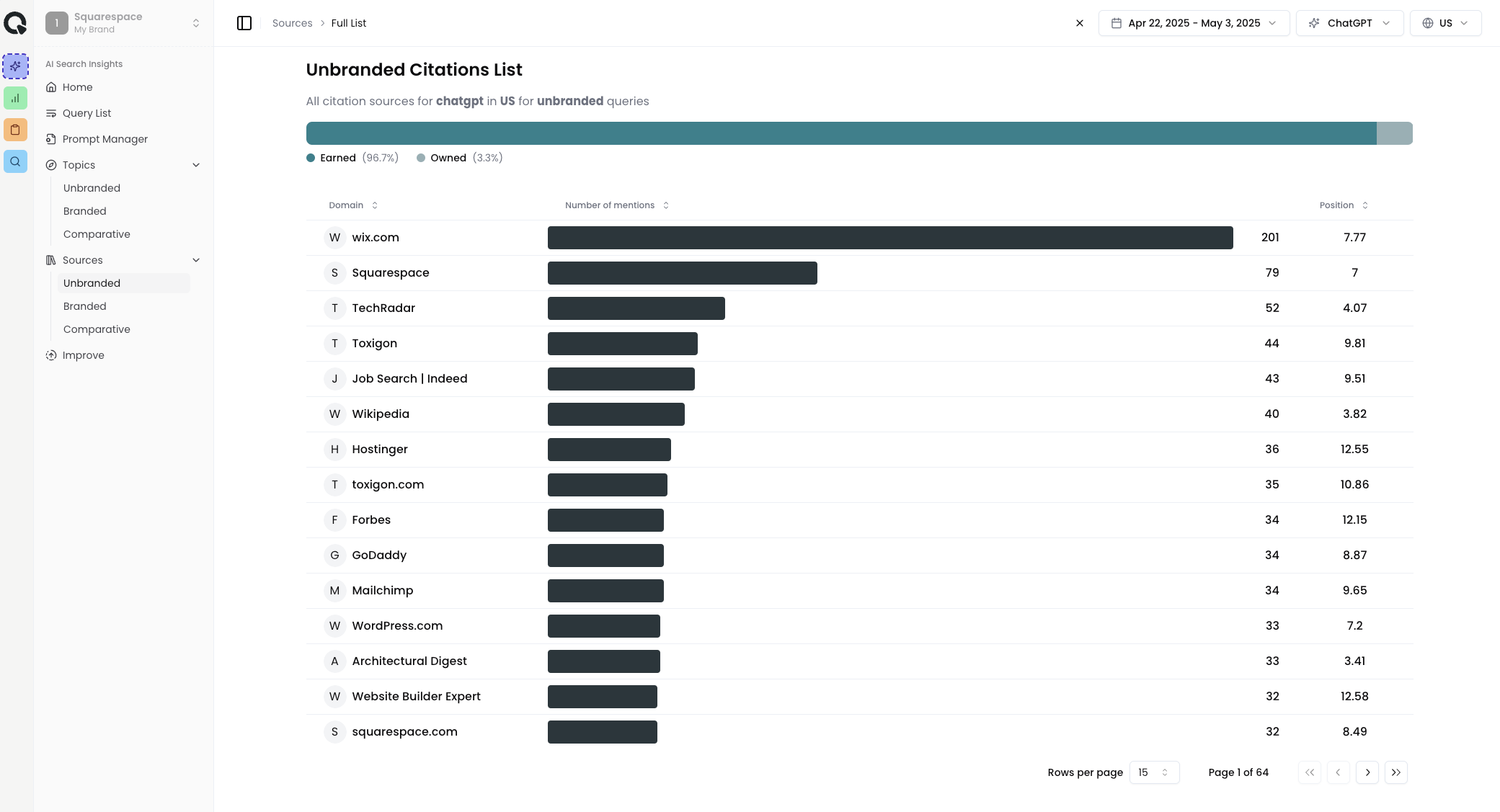
We track the **most frequently cited domains** for each brand and prompt, along with their **relative domain authority (DA)**. You'll see:
* The top domains shaping AI responses
* Specific URLs linked to individual prompts
* Whether you or a competitor is being cited more often
> **Goal**: Optimize your own content to become the most cited source in high-value answers.
### Content Authority
We classify each source by **content type**, including:
* Blog posts
* Product pages
* News articles
* Reviews
* Video transcripts
* Press releases
This lets you identify the **dominant content formats** that AI models prefer — and target gaps accordingly.
> Example: If product comparisons often cite review blogs, but your brand has no review coverage, that's a gap worth filling.
***
## Owned vs. Earned Visibility
Every source is labeled as:
* **Owned**: Created or published by your brand (e.g. your .com, pressroom, blog)
* **Earned**: External sources that reference or describe you (e.g. news articles, review sites, Reddit threads)
This breakdown helps you quantify:
* How much of your visibility is directly controlled
* Where third-party voices are shaping the narrative
* Opportunities to convert earned visibility into owned authority (via partnerships, content syndication, etc.)
***
## Why It Matters
Knowing *what* content AIs are citing is just as important as knowing *if* your brand shows up. Source analysis lets you:
* Pinpoint which pages and platforms are influencing AI rankings
* Identify gaps in content type, geography, or language
* Reclaim control over your brand story in AI-generated responses
* Focus SEO and content efforts where they have real impact on AI outputs
By auditing and optimizing your source footprint, you can ensure that AI models see — and cite — your brand as an authoritative, trusted source.
## Breakdown by Dimension
Each citation extracted from AI-generated content is categorized using the variables defined in [Visibility Monitoring](/overview/visibility-monitoring#tracking-dimensions)
This lets you evaluate how authoritative and aligned your sources are at each decision stage.
***
## Source Quality & Type
### Domain Authority
We track the **most frequently cited domains** for each brand and prompt, along with their **relative domain authority (DA)**. You'll see:
* The top domains shaping AI responses
* Specific URLs linked to individual prompts
* Whether you or a competitor is being cited more often
> **Goal**: Optimize your own content to become the most cited source in high-value answers.
### Content Authority
We classify each source by **content type**, including:
* Blog posts
* Product pages
* News articles
* Reviews
* Video transcripts
* Press releases
This lets you identify the **dominant content formats** that AI models prefer — and target gaps accordingly.
> Example: If product comparisons often cite review blogs, but your brand has no review coverage, that's a gap worth filling.
***
## Owned vs. Earned Visibility
Every source is labeled as:
* **Owned**: Created or published by your brand (e.g. your .com, pressroom, blog)
* **Earned**: External sources that reference or describe you (e.g. news articles, review sites, Reddit threads)
This breakdown helps you quantify:
* How much of your visibility is directly controlled
* Where third-party voices are shaping the narrative
* Opportunities to convert earned visibility into owned authority (via partnerships, content syndication, etc.)
***
## Why It Matters
Knowing *what* content AIs are citing is just as important as knowing *if* your brand shows up. Source analysis lets you:
* Pinpoint which pages and platforms are influencing AI rankings
* Identify gaps in content type, geography, or language
* Reclaim control over your brand story in AI-generated responses
* Focus SEO and content efforts where they have real impact on AI outputs
By auditing and optimizing your source footprint, you can ensure that AI models see — and cite — your brand as an authoritative, trusted source.